When Nothing Is Urgent, Patients Get Left Behind

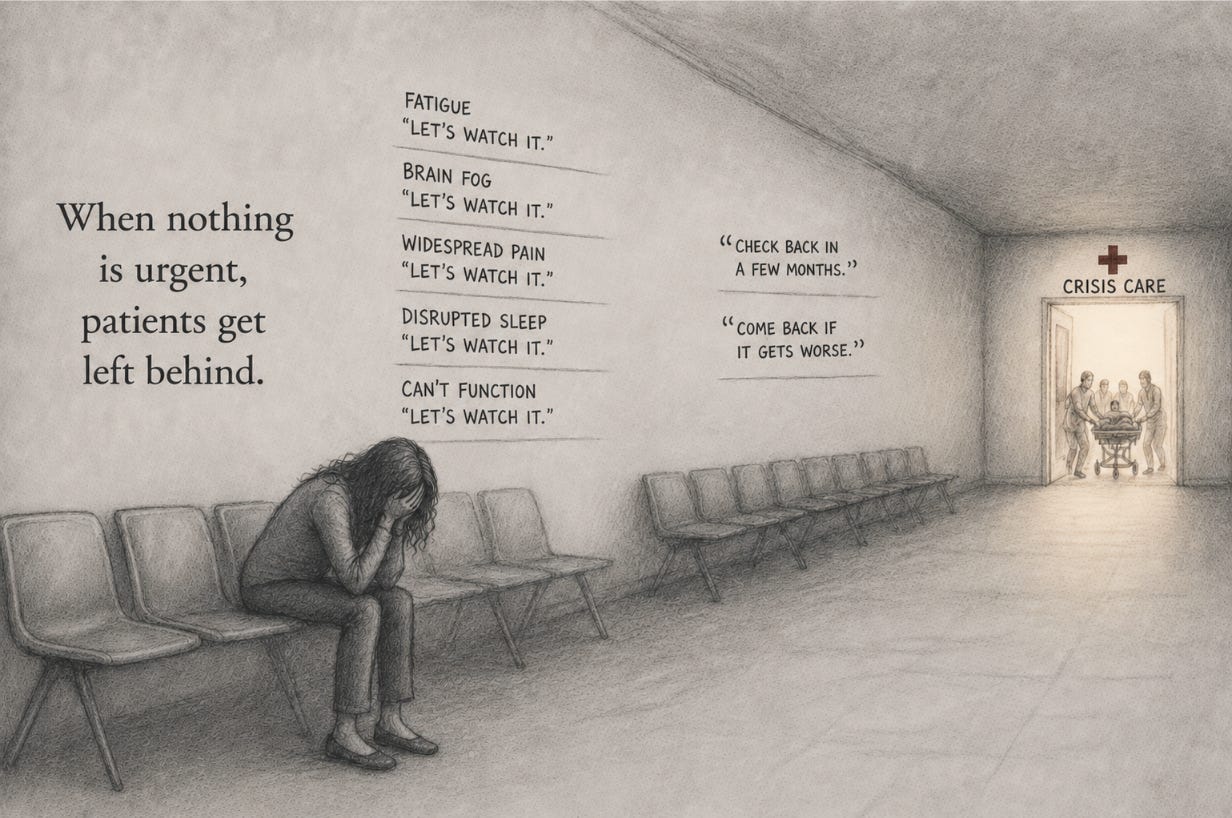
A Michigan woman was dismissed by doctors for years before she was finally diagnosed with Lyme disease. A former therapist from Phoenix spent over a year in bed with debilitating symptoms before a Long COVID diagnosis. Patients with fibromyalgia wait more than six years on average to be accurately diagnosed, and people with chronic fatigue syndrome (ME/CFS) can wait even longer.
Millions of patients with a range of conditions face similar delays. That’s because healthcare prioritizes acute conditions like heart attacks, strokes, and rapidly escalating infections. When it comes to symptoms that don’t read like a medical drama—widespread pain, disturbed sleep, brain fog—action is rarely immediate. Instead, patients are prescribed a wait-and-see approach: “let’s watch it,” “check back in a few months,” or “we’ll keep an eye on it.”
Caution is a cornerstone of good medicine. But when symptoms don’t let up and providers don’t act, the burden shifts to patients who are desperate for help. “Come back if it gets worse” is too often a precursor to things indeed getting worse. Patients with chronic conditions begin to decline, sometimes significantly, until untreated symptoms become critical enough to warrant care.
The cost of wait-and-see
The system is conditioned to intervene during crises, not before them. While we all want healthcare that steps up in an emergency, it’s also essential to recognize threats that escalate gradually. Medicine has well-established standards of care for chronic conditions, but training is centered on acute events doctors can diagnose and treat decisively. Although this works well in emergencies, it can fail patients whose symptoms worsen by the day, week, or month rather than the hour.
The consequences are cumulative and measurable. Each year, the healthcare system sees millions of patients with chronic conditions before they are diagnosed—delays that drive up costs and inefficiency nationwide. Chronic pain alone is estimated to cost the U.S. economy more than $720 billion annually in medical bills and lost productivity, much of it directly linked to conditions with serious symptoms that go untreated. Long COVID has added to that toll with an annual economic impact of up to $230 billion.
More concerning is that people diagnosed with chronic conditions don’t always receive treatments developed to manage them. For example, only about 5% of patients diagnosed with fibromyalgia are prescribed an FDA-approved therapy. Delayed, fragmented, and ineffective treatment further strains the system as patients seeking relief come back again and again. Meanwhile, new patients add to the surging demand. Delayed care does not reduce pressure on the system. It compounds it.
The answer isn’t “either or.” It’s “both and.”
Acute symptoms should not be the only trigger for swift medical attention. Symptoms that persist, worsen, and disrupt daily life should also compel thoughtful and timely intervention. The current system rewards treatment of the most critical cases instead of the best outcomes for emergency and non-emergency patients alike. In addition to reducing costs, diagnosing and treating chronic conditions sooner would reduce patients’ suffering and meaningfully improve their lives.
Medical education should equip clinicians to recognize patterns of debilitating symptoms and to act before patients reach emergency thresholds. Primary care clinicians need guidelines that escalate care as patient risk increases, even when symptoms are not yet acute. Training should emphasize proactive care for both emergencies and emerging conditions, especially when taking action would prevent further deterioration and repeat visits. Policy can reinforce this shift, with reimbursement models that support time spent evaluating complex, persistent symptoms just as they support procedures or urgent measures.
We can save lives both in emergencies and through routine care that is vigilant for emerging threats. There is always room for caution, and there is always a need for healthcare that thinks ahead to prevent the next crisis. Because when care is delayed, too many Americans get left behind.
About the Author
Seth Lederman is co-founder, CEO and chairman of Tonix Pharmaceuticals Holding Corp., a biotech company dedicated to developing novel medicines for central nervous system disorders.